The full picture at a glance
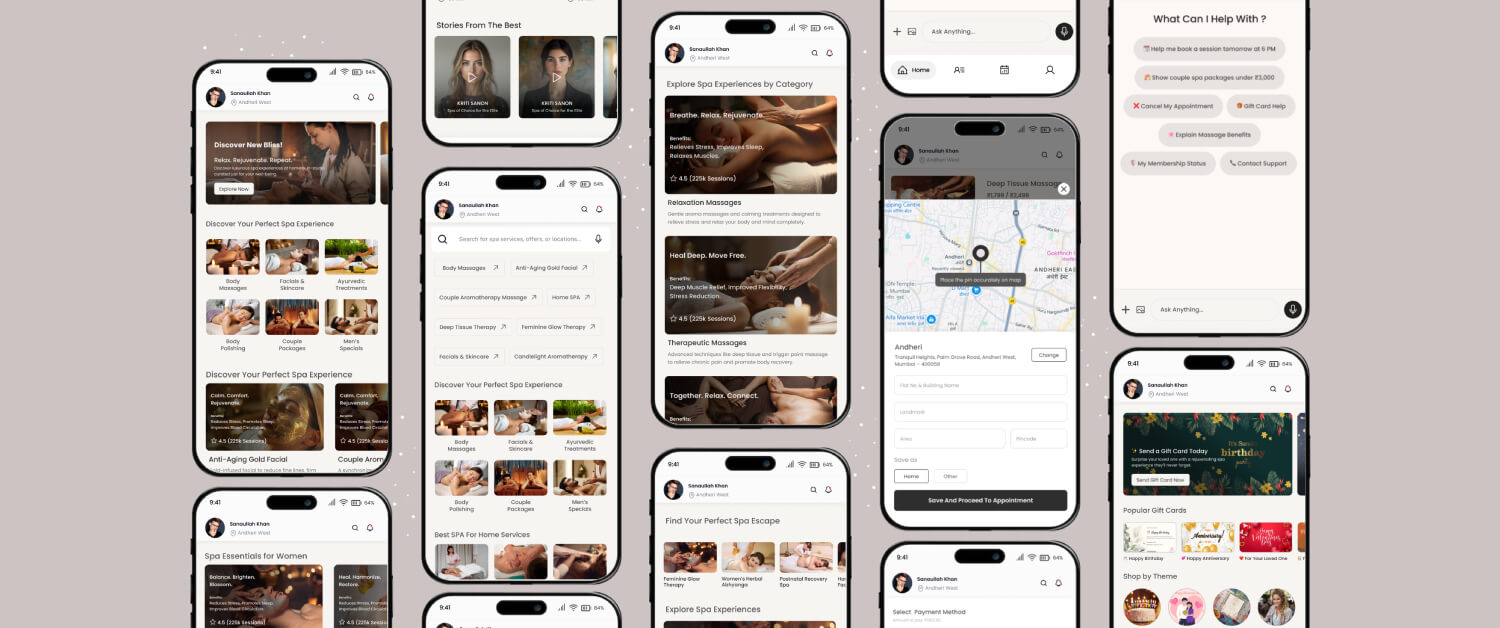
Buddha Spa is a wellness and spa aggregator platform that allows users to discover, compare, and book spa services across categories like male spa, female spa, couple spa, and home services. It offers curated membership plans, personalized recommendations, and location-based offers — creating a seamless experience from spa discovery to appointment booking.
Designed for users seeking stress relief, luxury experiences, or therapeutic sessions, Buddha Spa bridges the gap between wellness seekers and verified spa providers. With a growing demand for self-care and personalization, the platform aims to become a go-to destination for wellness enthusiasts across India.
As Product Owner and UX Strategist, I led the complete design thinking cycle — from research and persona development to Generative AI integration, service blueprinting, high-fidelity prototyping, and usability testing. The project ran over 6 weeks and delivered a pixel-perfect, development-ready design system.
What was broken
Despite offering quality services and a rich network of spa partners, Buddha Spa faced critical UX and engagement challenges. Users were frustrated by confusing navigation, lack of therapist transparency, and absence of gender-specific filters. The experience was further weakened by unclear service descriptions and the inability to book couple or home sessions easily — making the spa booking journey less safe, less personalized, and ultimately ineffective.
Through user research and discovery, six interconnected problem areas emerged:
These gaps revealed a strong opportunity to embed Generative AI and Large Language Models (LLMs) to deliver smarter, faster, and more personalized experiences across the user journey.
Understanding users deeply before designing
Research was conducted using both quantitative and qualitative methods to understand user pain points, motivations, and behaviors around spa booking across different personas — individuals, couples, and professionals.
User Job Stories — 4 core scenarios explored from real contexts, 6 UX layers analyzed to drive design decisions:
| User Context (Need) | User Motivation | Expected Outcome | UX Solution |
|---|---|---|---|
| I'm new to spa, unsure what's right for me | Explore services matching my needs | Discover a spa matching mood & lifestyle | AI Spa Match tool with guided questions & suggestions |
| I want a safe, gender-specific therapist | Filter by therapist gender & service preferences | Book comfortably without stress | Visible gender filters + verified therapist badges |
| I don't want to waste time searching | Fast results based on location & timing | Find and book a spa near me within minutes | Smart filters: distance, availability, wallet offer suggestions |
| I've booked and want to feel prepared | Check instructions & reminders pre-session | Arrive confidently knowing what to expect | Confirmation with visual care guide, therapist name & reviews |
A 6-week design sprint in action
Our design process combined research, usability feedback, and iterative wireframes to deliver a personalized, safe, and calming spa experience — tailored to user emotions and behavior. The process ran across 6 structured phases with clear day-by-day milestones.
Conducted research, user interviews (15 sessions), online surveys (200+ respondents), and empathy mapping to gather real user pain points, emotional triggers, and safety concerns around spa booking. Competitive analysis of existing spa apps.
Identified unclear services, trust issues, and navigation problems as core usability challenges. Created user personas (Arjun, Riya, Neha & Karan), customer journey maps across 7 stages, heuristic evaluation, and user job stories to frame the design problem precisely.
Created a mobile-first layout with gender-safe filter options and personalized spa discovery flows. Mind-mapped the full solution architecture including AI Chatbot integration, AI Spa Suggestions, Wallet Feature, Chatbot Integration, and Design System. Brainstormed 7 Generative AI use cases.
Built low-fidelity sketches and wireframes first, then transitioned to high-fidelity Figma prototypes across all key user flows — Home, Search, Filters, Spa Detail, Booking, Payment, Confirmation, AI Chat, Wallet, and Gift Cards. Created a complete design system with Poppins typography and an 11-color palette.
Ran usability tests with actual users and internal staff to identify friction and improve navigation ease. Tested across core flows: booking, filter selection, and service discovery. A/B tested key interaction patterns. Collected qualitative feedback that shaped final iterations.
Finalized the UI, established a full design system (color palette, typography, spacing, component library, icon set), and prepared pixel-perfect assets for developer handoff. Created comprehensive documentation for UX metrics alignment, AI feature roadmap, and future dev phases.
What we actually designed & solved
7 Generative AI Features designed or proposed — inspired by user needs:
| # | Feature | Role of Generative AI | Solution / Benefit |
|---|---|---|---|
| 01 | Personalized Spa Recommendations | AI analyzes user data to rank and personalize spa listings | Saves time, increases bookings with relevant options |
| 02 | Auto-generated Offer Banners | AI writes banner text and selects layout style automatically | Reduces manual design work, speeds up marketing rollouts |
| 03 | WhatsApp Chatbot Assistant | AI powers natural language understanding and response generation | 24/7 assistance, reduces manual support load |
| 04 | Auto-filled Appointment Forms | AI predicts and auto-fills user data intelligently | Reduces booking drop-offs, streamlines user flow |
| 05 | Testimonial Summarizer | AI extracts sentiment and key phrases from long reviews | Builds social proof efficiently without manual editing |
| 06 | Membership Plan Writer | AI uses plan input to auto-generate benefits, titles, structure | Accelerates launch of new plans with clarity for users |
| 07 | Dynamic Category Naming | AI analyzes keywords and renames categories for relevance | Enhances discoverability and improves SEO & UX |
Results that validated the design
After usability testing with real users and internal staff across core flows (booking, filter selection, spa discovery), the redesigned Buddha Spa platform delivered significant measurable improvements in usability, trust, and engagement.
What users said in usability testing:
Strategic LLM Impact — how Generative AI drives business outcomes:
| # | Focus Area | How LLMs Help |
|---|---|---|
| 01 | User Retention | Deep personalization builds trust and satisfaction — users return when they feel understood |
| 02 | Revenue Growth | Smart upselling and gifting boosts conversion — AI Gift Message Generator increases gift card sales |
| 03 | Operational Efficiency | Fewer customer queries reach human agents — LLM concierge handles FAQs, booking changes, and cancellations |
| 04 | Brand Loyalty | Emotional experiences and tailored tone enhance loyalty — users associate Buddha Spa with feeling understood |
Key learnings as UX Researcher & Product Owner
This project was an opportunity to bridge strategy and empathy at a deep level. As a UX Researcher, I began with understanding user needs through direct interviews, empathy mapping, and journey analysis. As a Product Owner, I translated those insights into strategic features like verified therapist filters, personalized discovery, and AI-based spa matching. Here are the core lessons carried forward:
-
01Deep user understanding drives better design. Research first always pays off. Every major design decision in this project traced back to a specific user insight — not an assumption. The gender filter, pre-session guide, and AI match tool all came directly from interview findings.
-
02Small UI changes make huge trust improvements. Adding a gender toggle, showing therapist verification status, and displaying time slot availability in real-time were minor implementation changes — but created massive trust improvements for female and safety-conscious users.
-
03Personalization builds retention. Users return when they feel understood. The AI recommendation engine didn't just improve discovery — it changed how users emotionally related to the platform. Personalization isn't a feature, it's a retention strategy.
-
04Generative AI must be designed with empathy, not just capability. The most effective AI features in this project were the ones rooted in real emotional pain points — not technical showcases. The AI Gift Message Generator worked because it solved a genuine human problem: writing heartfelt messages under time pressure.
-
05A structured design process and design system accelerate delivery. The 6-week sprint was aggressive. Having a clear day-by-day process (Empathize → Define → Ideate → Prototype → Test → Implement) and building the design system in parallel meant dev handoff was smooth, accurate, and fast.